
Water. The lifeblood of any car wash. Without clean, soft water, the quality of the wash results you produce will literally go down your drains. Poor water quality can be the root of a variety of problems in the performance and longevity of your wash. Using water with high levels of minerals and other contaminants can leave an unsightly residue on cars. These minerals can also lead to equipment damage over time. In addition, treating water in car washes is a key process of the industry’s sustainability efforts.

Running a Reverse Osmosis (RO) system is crucial for delivering a spot-free rinse. An RO system purifies water by forcing it under pressure through a semi-permeable membrane. The membrane acts like a microscopic sieve, blocking contaminants like salts, minerals, and bacteria while letting pure water molecules pass through, resulting in cleaner, better-tasting water stored in a tank for use. The process usually involves multiple stages: sediment/carbon pre-filters remove larger particles and chemicals, the RO membrane handles dissolved solids. Using an RO system directly leads to improved customer satisfaction and can lower labor costs by reducing the need for manual drying. So where do you start? How do you know if you need an RO system, and how do you choose a unit that will suit the needs of your wash?
Getting to Know Your Water
If you’re a wash owner, hopefully you already have a good idea about the water quality you have in your wash. Even if you’re not 100 percent sure about your parameters, test your water. If your water leaves white spots and your soap doesn’t lather well, you likely have hard water, which contributes to your TDS (Total Dissolved Solids). You test car wash water using handheld kits or meters for pH, hardness, and TDS to check water quality. A pH strip or digital meter tests the water’s acidity (acidic is softer vs alkaline is hard), a hardness titration test kit measures mineral content, and a TDS meter measures dissolved mineral salts that cause spotting. This is the first step to ensure your water doesn’t cause spots or reduce chemical effectiveness.
Understanding TDS vs. Water Hardness
Total Dissolved Solids (TDS) measures all dissolved minerals, salts, and metals, while hard water specifically measures only calcium and magnesium, the minerals causing scale. Hard water contributes to TDS. Hard water generally has high TDS, but high TDS doesn’t always mean hard water. That will depend on what makes your water hard. Both indicate water quality issues but require different solutions: softeners for hardness, or reverse osmosis (RO) for overall TDS reduction.
Total Dissolved Solids (TDS)

- What it is: A broad measure of all inorganic and organic matter dissolved in water (salts, minerals, metals, etc.).
- Units: Parts per million (ppm) or milligrams per liter (mg/L).
- Source: Natural (rocks, soil) and man-made (runoff, chemicals).
- Impact: High levels can affect taste and indicate contaminants, but not always harmful; very high levels (e.g., >2000ppm) can be unsafe.
Water Hardness
- What it is: The concentration of calcium and magnesium ions.
- Units: Grains per gallon (gpg) or mg/L.
- Source: Water passing through mineral-rich underground deposits like limestone.
- Impact: Causes soap scum, scale build-up in pipes, and appliance inefficiency; can make lathering difficult.
Key Differences & Relationship
- Scope: Hardness is a subset of TDS.
- Measurement: TDS measures everything; hardness only calcium/magnesium.
- Water Softeners: Exchange minerals (like sodium for calcium/magnesium) but don’t significantly lower overall TDS.
- Reverse Osmosis: Reduces both hardness and TDS by removing most dissolved substances.
Choosing Your RO System
Choosing the right RO system for your car wash is a process. It means matching the system’s Gallons Per Day (GPD) output to your peak usage, considering your tunnel/bay size, car count, and water needs (GPM). You’ll also need to account for variable factors like water temperature, and having a storage tank (e.g., 250+ gal) to buffer supply, ensuring steady flow for spot-free rinses without downtime.
Calculate Your Water Needs
Your first step is to get an accurate estimate on the amount of water you use in your wash. Your RO system’s output should meet or exceed this the max Gallons Per Day (GPD) you need.
To calculate car wash water usage, check your main water meter to get total usage, then divide by the number of cars through your bays for average per-car use, considering fresh vs. reclaimed water, equipment (pressure wands use more), and wash cycles. For precise figures, track individual components like pre-soak, high-pressure rinse, and final rinse, often using specific flow rates (GPM) or manufacturer data, especially for different packages or self-serve bays. Estimate your total daily water consumption for all wash processes to get your average total daily usage. Wash type, tunnel length, number of bays, and attended/unattended status can affect your demand for RO water. Higher traffic volume means also means more water will be needed. Your goal is to identify where RO water is used in your wash (e.g., final rinse) and how much.
Next, consider RO System specs. Systems are generally rated by Gallons Per Day (GPD). This can drop significantly with cold water or high contaminant levels. A system might produce 1000 GPD, but if its flow rate is low (e.g., 2 GPM), it might not keep up with high-demand rinse cycles. Again, it’s important to test your source water, as poor initial water quality may affect membrane life and production more.
Considering Storage and Pressure
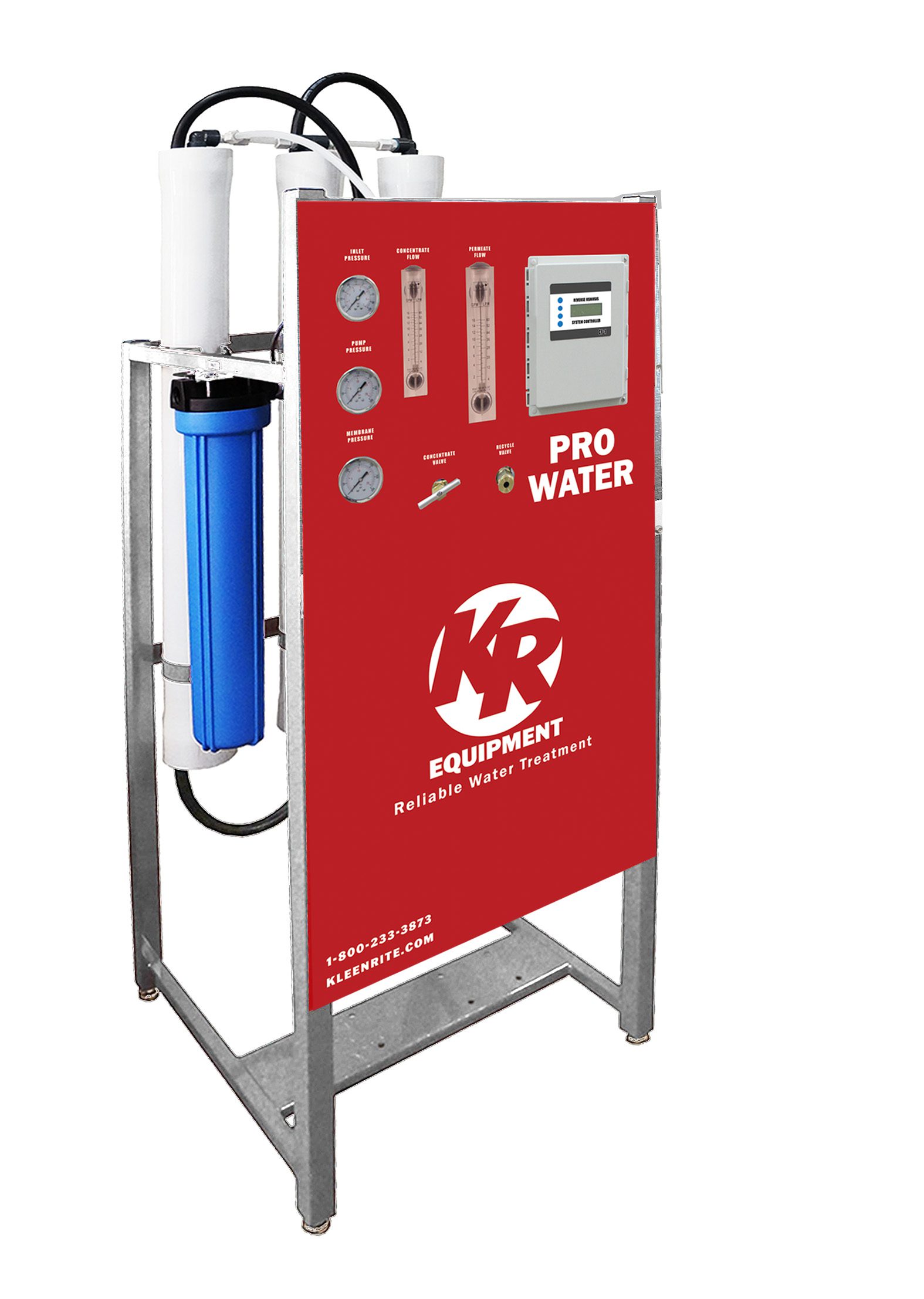
Don’t forget to consider storage and pressure. When deciding on your storage tank, remember that a larger tank provides a buffer, allowing purification at a steady rate while meeting sudden demand spikes in your wash bays. Make sure your system has adequate pressure (40-80 PSI) for optimal performance, adding a booster pump if necessary. An RO system may need a booster pump primarily for low water pressure (below 40-50 PSI). It will help to increase the system’s production rate, improve water quality by forcing contaminants out, and reduce wasted water. It will also help with high TDS water or well systems by optimizing membrane efficiency and saving DI resin. Basically, it provides the necessary force for the membrane to work well, leading to faster, better filtration and less drain water.
Finally, choose your system size. Select a system (like those rated 1,000-7,500+ GPD) that provides enough water for your peak GPM and daily needs. Systems range from smaller units for single bays to larger ones (e.g., 5-20 HP) for high-volume operations.
Give us a call for to discuss more complex operations. We can help you size the system based on your specific water quality, usage, and space for an effective, long-lasting set-up.
RO System Maintenance
Car wash RO (Reverse Osmosis) maintenance focuses on regular pre-filter changes, monitoring water quality (TDS, pH, Chlorine), checking flow/pressure, and ensuring the carbon filter protects the membranes, preventing scale and spotting for spot-free rinses. Key tasks including monthly filter swaps and periodic membrane flushing/replacement based on TDS readings.
Routine Maintenance (Monthly/As Needed):
- Prefilters: Replace sediment and carbon pre-filters monthly, or sooner if flow drops, as they catch debris and chlorine that can damage membranes.
- Water Testing: Test incoming water for TDS, pH, and chlorine; test the RO product water for TDS (aim for near zero).
- Carbon Filter: Ensure it’s effectively removing chlorine; high chlorine destroys membranes quickly.
- Flow & Pressure: Verify correct flow rates and pressures to prevent waste and ensure production.
- Monitor TDS levels: rising TDS indicates the membrane needs cleaning or replacement.
- Water Softener: Crucial for preventing scale; check its performance weekly.
- Solenoids/Valves: Inspect for proper function and alignment
About the Author

Phil Donnelly, aka “Fix-It Phil”
Kleen-Rite Equipment Engineer, Production Manager, Car Wash Operator
Phil Donnelly is best known for his “Fix-It Phil” persona on Kleen-Rite’s YouTube channel and podcast Kleen-Rite Radio. Phil has become a trusted source of technical expertise for car wash owners, operators, and technicians. Beyond his on-screen guidance, Phil was the driving force behind the Operator Pro Plus pump stand. He spearheaded its design, testing, and production to create a highly effective solution for self-serve car washes. He also serves as the lead engineer and production manager for KR Equipment, our reliable line of car wash equipment. Our equipment is designed and produced in-house specifically for the self-serve segment of the industry.
Before joining Kleen-Rite, Phil spent over 14 years servicing industrial boilers at Delval Equipment. This experience provided a strong technical foundation skills and knowledge, enabling him to quickly master the equipment used in car washes. Phil attended Thaddeus Stevens College of Technology and graduated from the HVAC-R program with an Associate Degree.